
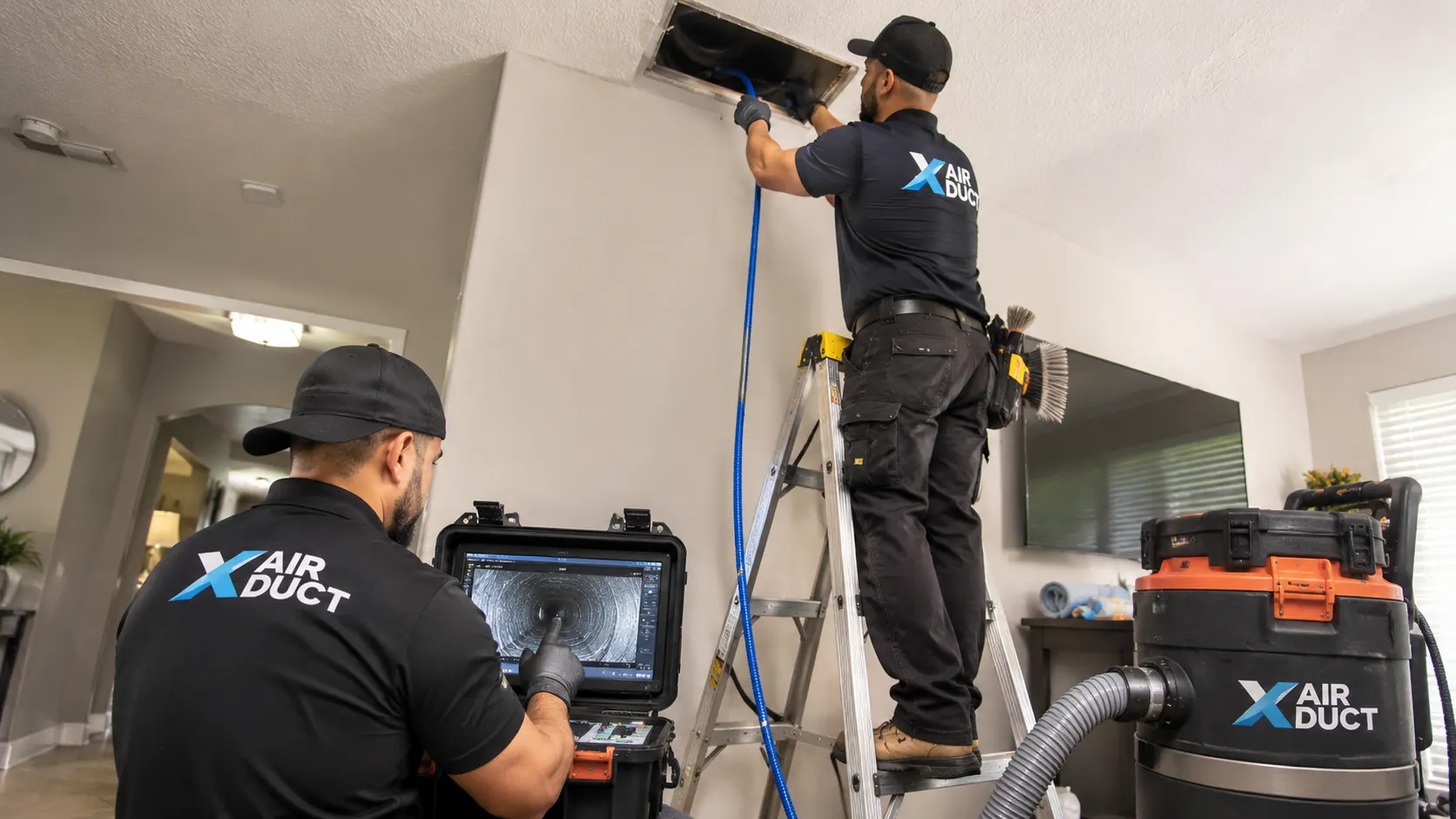
If you live or manage property in Cutler Bay, FL, X Air Duct can help you understand the condition of your ducts and dryer vent and decide what, if anything, needs to be done. We bring 18 years of hands-on industry experience and a commitment to plain explanations.
Cutler Bay is a primarily residential community of single-family subdivisions, some near Biscayne Bay. Single-story homes with attic ducts are common.
Single-story homes
Cutler Bay has many single-story homes with closet or garage air handlers and attic ducts, offering direct access for inspection.
Bay-adjacent humidity
Homes near Biscayne Bay should keep an eye on indoor humidity. The EPA recommends keeping it below 60 percent.
Dryer vents
Short wall vents are common; check the transition hose behind the dryer for kinks.
Before treating a moisture concern as a cleaning issue
For a Cutler Bay home with dampness, water staining, or a persistent musty odor, identify the moisture concern separately from any request to remove dust. Ask an appropriate professional to evaluate leaks, drainage, or HVAC performance. Cleaning alone cannot correct a moisture source or establish that a suspected substance is mold.
Once the underlying condition is understood, inspection can help decide whether particular accessible duct components need attention. Duct material matters: damaged insulation and contaminated porous materials may require a different response from cleaning bare metal. For laundry concerns, include the known vent exit and any restriction symptoms. Keep water damage, dryer exhaust, and general room ventilation as related maintenance topics, not interchangeable diagnoses.
Services available in Cutler Bay
Residential property considerations in Cutler Bay
Cutler Bay housing includes single-family subdivisions and bay-adjacent neighborhoods. Each type brings different access, layout, and maintenance considerations.
Single-family suburban homes usually give the most direct access to their duct systems: a closet or garage air handler, an attic hatch, and registers in every room. That accessibility makes a thorough inspection practical and lets homeowners watch the camera feed alongside the technician.
Canal-front and Intracoastal homes often have outdoor living spaces, docks, and doors that open toward the water. Moisture-laden air entering through open doors, along with salt exposure, makes humidity awareness and exterior component checks important.
Master-planned and HOA communities often feature similar builder floor plans, typically with an air handler in a closet or garage and flexible duct branches in the attic. Even so, individual renovations, equipment changes, and attic work make every home different by now. Flexible duct needs gentle cleaning tools, and connections in hot attics deserve a look.
Commercial property considerations in Cutler Bay
Community clubhouses, amenity centers, and HOA-managed buildings can benefit from scheduled inspection, coordinated through the management company.
How we approach a Cutler Bay appointment
- 01Discuss the property, system, access, and any building or HOA rules.
- 02Examine accessible registers, returns, and vent paths, often with a camera.
- 03Protect floors and furnishings along the work path.
- 04Clean with tools matched to the duct or vent material, when warranted.
- 05Explain what was cleaned and what could not be reached.
- 06Recommend maintenance habits and a sensible re-check window.
Dryer vent cleaning in Cutler Bay
Single-story suburban homes commonly vent the dryer straight through an exterior block wall, which is short and accessible. If your laundry is in the garage or an interior room, the run may be longer and pass through the ceiling.
Waterfront homes frequently vent dryers toward the yard or a side wall. Hoods facing prevailing breezes can be pushed shut or collect debris; checking the flap is a simple monthly habit.
Whatever the route, the U.S. Fire Administration recommends cleaning the lint filter with every load and keeping the vent and exterior exhaust clear. X Air Duct cleans and inspects dryer vents; if we find crushed, disconnected, or improperly installed ducts, we explain what we see so you can contact a qualified installer.
Ventilation care for Cutler Bay properties
Families with pets and busy households load filters faster. Check them monthly and replace with the size and type your equipment specifies.
Waterfront owners should watch indoor humidity closely. The EPA recommends keeping it below 60 percent, ideally 30 to 50 percent, and a simple hygrometer makes that easy to monitor.
Across Cutler Bay, as everywhere in South Florida, air conditioning runs much of the year. That makes filter discipline, condensate drain maintenance by a licensed HVAC contractor, and indoor humidity control (the EPA recommends below 60 percent, ideally 30 to 50 percent) the foundation of good ventilation care. Duct cleaning complements those habits; it does not replace them.
Questions from Cutler Bay property owners
01Does X Air Duct serve Cutler Bay, FL?
Yes. Cutler Bay is part of our service area in Miami-Dade County. Email info@xairduct.com or use the estimate request page to share your address details and the service you are interested in.
02How do I prepare my single-family home for duct cleaning?
Clear access to registers, returns, the air handler, and the attic hatch; secure pets; and plan to be there for the opening assessment and closing walkthrough.
03Should waterfront homes worry about humidity in ducts?
Humidity is a whole-home issue rather than a duct-only issue. Keep indoor relative humidity below 60 percent, per EPA guidance, fix leaks and drainage problems, and have a licensed HVAC contractor check equipment if levels stay high. Duct cleaning does not control humidity.
04Do newer planned-community homes need duct cleaning?
Not automatically. Newer homes with good filter habits may only need an inspection to confirm conditions. Cleaning is worth considering after renovations, pest issues, or when inspection shows real buildup.
05How often should Cutler Bay homeowners clean their air ducts?
There is no fixed interval. Following EPA guidance, consider cleaning when inspection shows substantial buildup, after renovations, or after pest activity has been resolved. Many homes need it infrequently.