
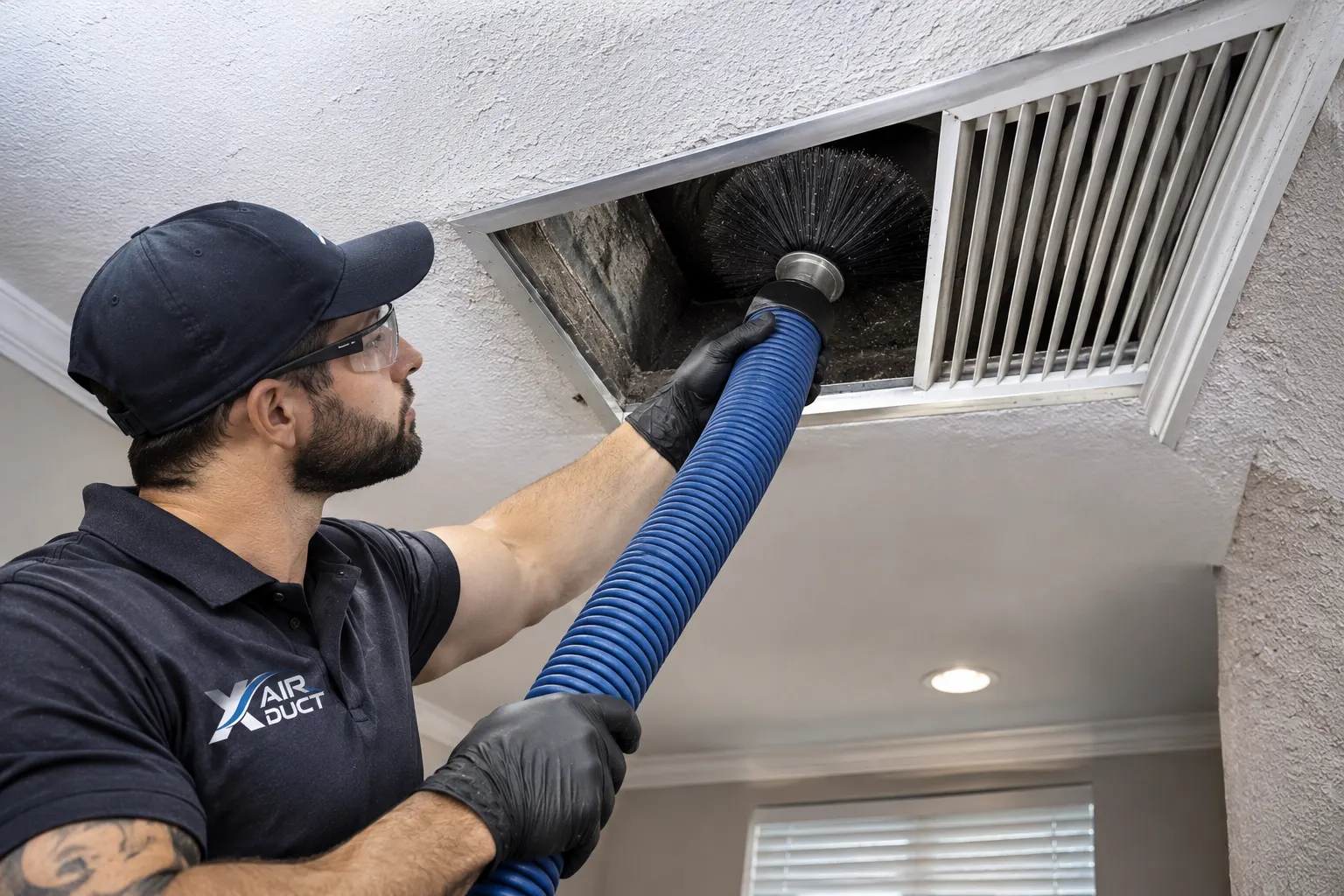
What air duct cleaning is
Air duct cleaning is the removal of settled dust, debris, and loose particulate from the supply and return ducts that carry conditioned air through a home or building. A proper job treats the system as a whole: the registers and return grilles you can see, the duct runs behind ceilings and walls, and the connections near the air handler where debris often collects first.
X Air Duct brings 18 years of hands-on industry experience to this work. That experience matters less for the cleaning itself than for the judgment around it: deciding whether a system actually has buildup worth removing, choosing tools that suit the duct material, protecting the property while work is underway, and explaining honestly what was found.
The U.S. Environmental Protection Agency describes duct cleaning as something to consider on an as-needed basis rather than as a routine requirement for every home. We agree, and we build our conversations around that principle.
Who may need it
- Homeowners who see heavy dust or debris inside supply registers or visible duct sections, beyond the light film that settles on any grille.
- Owners finishing a renovation where drywall dust, sawdust, or construction debris may have entered open returns or registers.
- Buyers moving into a property with an unknown maintenance history who want to understand the condition of accessible ductwork.
- Property managers preparing a unit between occupants and wanting a documented look at the system.
- Anyone who has found signs of pests or nesting material near registers or accessible duct runs, after the pest issue itself has been handled.
Signs that an inspection may be useful
- Debris or dust clumps visibly blowing out of supply registers when the system starts.
- Thick buildup visible past the register face when you remove a grille and look inside with a flashlight.
- Construction dust that reappears on surfaces soon after cleaning, following recent remodeling.
- An unusual musty odor near registers, which calls for finding the moisture source before anything else.
The inspection and cleaning process
- 1
Discuss the property
We ask about the system type, recent work on the home, what prompted the call, and any access concerns before scheduling.
- 2
Look at accessible components
Registers, returns, and reachable duct sections are examined, often with an inspection camera, to decide whether cleaning is warranted.
- 3
Prepare the work area
Floors and furnishings near the work path are protected, and equipment is staged so hoses and cords stay organized.
- 4
Clean accessible ductwork
Negative-pressure collection paired with agitation tools suited to the duct type loosens and captures debris.
- 5
Review results
We walk through what was cleaned, what could not be reached, and anything that should be evaluated by another trade.
- 6
Recommend next steps
Filter habits, moisture control, and a sensible re-inspection window are discussed, not a fixed resale schedule.
Equipment commonly used
- HEPA-filtered or negative-pressure collection units that draw loosened debris out of the duct system.
- Rotary brushes and air whips sized for duct dimensions, chosen to avoid damaging flexible duct liners.
- Inspection cameras for viewing duct interiors before and after cleaning.
- Register and grille hand tools, drop cloths, and floor protection.
Safety considerations
- The HVAC system is turned off during cleaning to avoid pulling loosened debris through the blower.
- Flexible ducts are handled with softer agitation because aggressive brushing can tear inner liners.
- Ladders, hoses, and cords are staged to keep walkways clear for occupants.
Typical system limitations
- Not every section of every system is reachable. Ducts sealed behind finished ceilings may only be partially accessible.
- Damaged, crushed, or disconnected ducts need repair by a qualified HVAC contractor; repair is not included in this cleaning service.
- Duct interiors with internal fiberglass lining that is deteriorating may need replacement rather than cleaning.
What this service does not accomplish
- It is not a proven way to prevent health problems. The EPA notes research has not established that duct cleaning prevents health issues.
- It does not fix humidity, condensation, or leaks. If moisture is present, the source must be corrected first.
- It does not replace changing your air filter or regular HVAC equipment maintenance by a licensed technician.
- It cannot guarantee a dust-free home; household dust comes from many sources besides ductwork.
How needs differ by property
A single-story home with a closet air handler and short attic runs is a very different job from a condominium where ducts run above a dropped ceiling with limited access panels, or a commercial suite where work has to be coordinated around business hours. Duct material matters too: sheet metal, duct board, and flexible duct each tolerate different tools. We size the approach to the system rather than applying one routine to every property.
What to ask before scheduling
- Will you look inside the ducts before recommending cleaning, and show me what you see?
- Which components are included: supply ducts, return ducts, registers, the area around the air handler?
- What tools will you use on my type of duct, and how will flexible duct be protected?
- What will you do if you find moisture, damage, or something outside your scope?
How often?
There is no single correct interval. The EPA advises cleaning when there is substantial visible buildup, evidence of pests, or contamination, rather than on a fixed calendar. Renovations, pets, and how well filters are maintained all change how quickly dust accumulates.
Air Duct Cleaning: frequently asked questions
01What is included in professional air duct cleaning?
A thorough job addresses the accessible supply ducts, return ducts, registers, and grilles, along with the areas near the air handler where debris tends to collect. Debris is loosened with brushes or air tools and captured by collection equipment under negative pressure. Scope varies by system and access, so a reputable company should define exactly which components are included before work begins.
Air duct cleaning service details02Do I need to leave my home during air duct cleaning?
Usually not. Most people stay home, though the HVAC system will be off during the work and there will be equipment noise. Many households choose to keep pets and young children in a room away from the work path. If someone in the home is sensitive to dust or noise, discuss it beforehand so the schedule can be planned accordingly.
03Can air duct cleaning damage ductwork?
It can if the wrong tools are used. Flexible duct and duct board are more delicate than sheet metal, and aggressive brushing can tear liners or loosen connections. Ask the company what tools they use on your duct type, and how they protect flexible runs.
04Can professional cleaning eliminate all dust in my home?
No. Household dust comes from people, pets, fabrics, outdoor air, and everyday activity. Duct cleaning can remove buildup inside the duct system, but it cannot make a home dust-free, and an honest contractor will not promise that.
05Do air filters replace the need for duct cleaning?
Filters and duct cleaning do different jobs. A properly fitted filter, changed on schedule, reduces how much dust reaches the system and is the single most useful maintenance habit. It does not remove debris that is already in the ducts, and it cannot catch dust that enters through gaps or leaks. Good filter habits often mean cleaning is needed less often.
Air duct cleaning vs. HVAC maintenance06Does every HVAC system require the same cleaning method?
No. Duct material, size, layout, and access all change the approach. Sheet metal tolerates firmer agitation, while flexible duct needs gentler tools. Commercial systems may involve larger trunk lines and above-ceiling access. A one-size routine is a warning sign.
Where we provide air duct cleaning
Available across Broward, Miami-Dade, and Palm Beach counties, including:
Photography is illustrative of the type of work we perform. It does not depict specific completed jobs or named employees.