
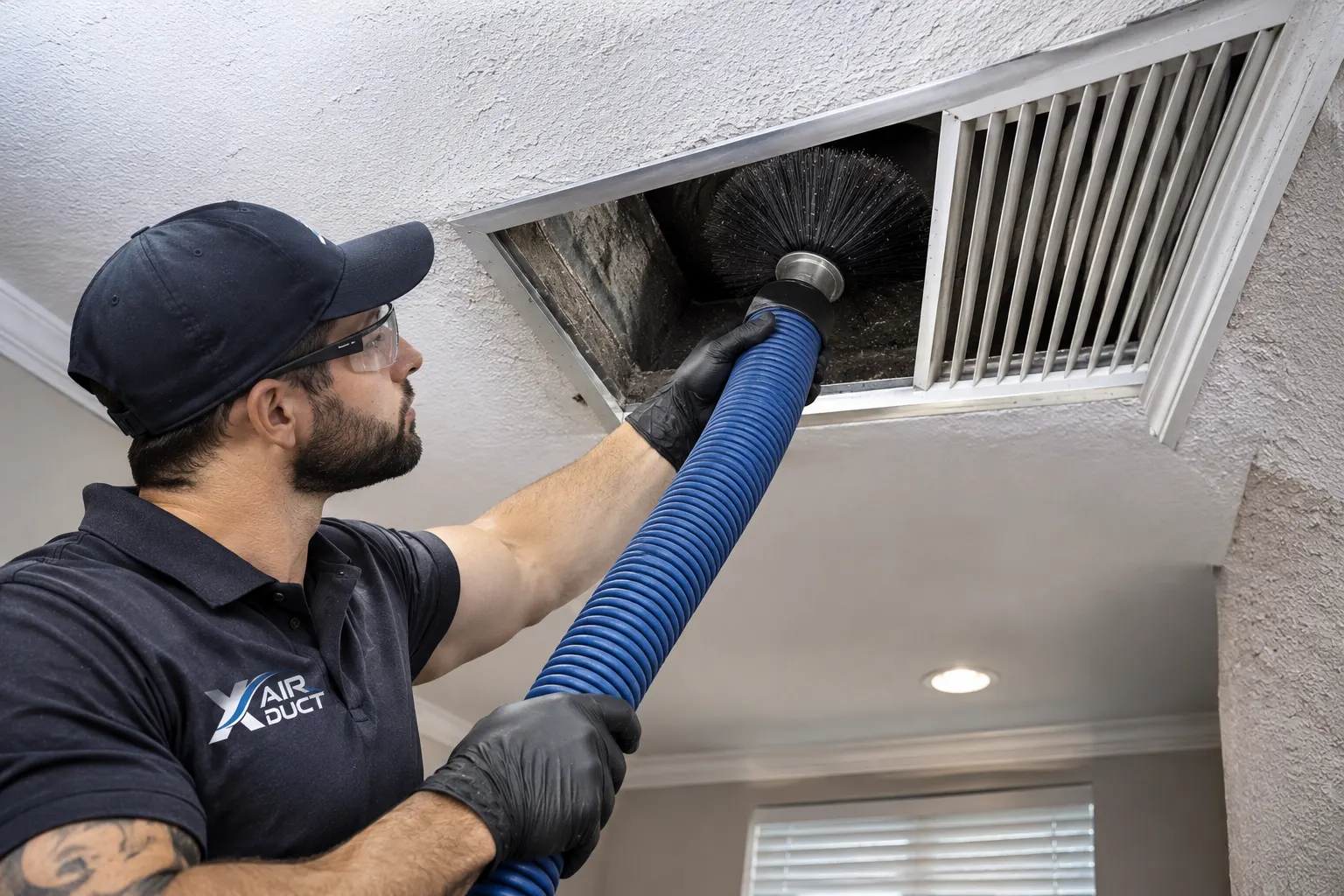
Air ducts are the circulatory system of a forced-air HVAC system. Supply ducts carry conditioned air from the air handler to registers in each room; return ducts bring room air back through a filter to be conditioned again. Every cubic foot of air moving through a home passes through this network.
This guide explains how dust accumulates in that network, what professional cleaning involves, how to decide whether you need it, and what it cannot do. It reflects the as-needed approach recommended by the U.S. Environmental Protection Agency and 18 years of hands-on industry experience at X Air Duct.
How a duct system is put together
Most South Florida homes have an air handler in a closet, garage, or attic. A return grille, often in a hallway ceiling or wall, pulls air through a filter. Supply trunk lines branch into smaller runs that end at registers. Ducts may be sheet metal, fiberglass duct board, or flexible duct with an inner liner, insulation, and an outer jacket.
Each material behaves differently during cleaning. Sheet metal is durable. Duct board has a fibrous interior surface that can be damaged by aggressive brushing. Flexible duct can tear or collapse if handled roughly.
Why dust accumulates
Dust enters through the return side, around poorly fitting filters, through gaps in return plenums, and through openings during construction. Most of it is ordinary household dust, which is why light accumulation is normal and does not, by itself, justify cleaning.
Cleaning methods
Effective cleaning pairs negative-pressure collection with mechanical agitation. Collection equipment draws air out of the system so debris moves toward a collector. Brushes, air whips, and similar tools then loosen debris branch by branch. The tools should match the duct material.
Inspection comes first
A visual and camera inspection is the most honest way to decide. It distinguishes surface dust on a grille from real buildup inside a duct, and it can reveal problems such as disconnections or moisture that call for a different professional.
What affects cost
The number of systems, registers, and returns; duct material; access difficulty; building rules; and whether dryer vent work is combined. Be cautious of extremely low advertised prices. X Air Duct does not publish flat prices because properties differ.
Limits and responsible expectations
The EPA notes that duct cleaning has not been shown to prevent health problems. If ducts are wet, the moisture source must be corrected, and wet or moldy insulation may need replacement. Cleaning cannot guarantee a dust-free home.
When the EPA says cleaning may be warranted
The U.S. Environmental Protection Agency takes a measured view. It states that duct cleaning has never been shown to actually prevent health problems, and that studies do not conclusively demonstrate that particle levels in homes increase because of dirty ducts. It also recognizes situations where cleaning makes sense: substantial visible mold growth inside hard-surface ducts or other components, ducts infested with insects or rodents, and ducts clogged with excessive dust and debris or releasing particles into the home from supply registers.
Those three conditions are the backbone of our recommendations. If none of them is present, we usually suggest maintaining the filter and checking again later. If one is present, we explain how cleaning addresses it and what else needs to happen, such as fixing a moisture source or sealing a pest entry point.
Inspection before cleaning
A camera inspection answers the most important question first: is there anything in the ducts worth removing? The technician looks into supply boots, the return plenum, and accessible trunk sections and shows you the monitor. Normal dust appears as a light, even film. Excessive buildup looks like matted layers or loose debris. Construction dust often shows as fine, pale powder concentrated near returns. Pest evidence and water staining are distinct and should be pointed out directly.
Inspection also identifies the duct materials, which determines the tools, and reveals sections that cannot be reached. That information belongs in the conversation before any cleaning starts.
What a complete cleaning covers
The EPA advises that if you decide to have ducts cleaned, the service provider should clean all components of the system: supply and return ducts and registers, grilles and diffusers, and, where within the provider’s scope, other components the air passes through. Cleaning only the easiest branches leaves debris that can redistribute. At X Air Duct, cleaning covers accessible supply and return ductwork, registers, grilles, and plenum areas reachable from the duct side. Coil cleaning, blower service, and chemical treatments are outside our services, and we tell you that up front.
Duct materials and how they change the job
Sheet metal ducts tolerate rotary brushes and are the most straightforward to clean. Fiberglass duct board has an interior surface that can release fibers if scrubbed aggressively, so gentler tools and careful technique are required; if it is damaged or wet, the EPA notes that replacement may be the better option. Flexible duct, common in South Florida attics, has a thin inner liner that can tear; air-driven tools and limited agitation are typically used, and crushed or disconnected sections are referred to an HVAC contractor.
Factors that shape cost and scope
We do not publish prices because two properties rarely need the same work. The factors that drive scope include the number of systems and air handlers, the number of supply and return openings, duct material and condition, access to attics or ceiling spaces, building rules in condominiums and commercial properties, and how much debris the inspection reveals. A clear estimate explains which of these apply to your property, and a reputable provider should not add surprise charges for work you did not agree to.
Red flags when hiring
The EPA cautions consumers about providers who make sweeping health claims, push chemical biocides or sealants without explanation, or quote very low prices for a whole house and then expand the work on site. Ask to see the inside of your ducts on camera before and after. Ask what will not be cleaned. Ask how the provider protects your home. If answers are vague or high-pressure, take your time.
Keeping ducts clean afterward
After cleaning, the habits that matter most are simple: use the correct filter size and change it when it is loaded, keep the air handler area clean and closed, seal obvious gaps around the return, protect registers and shut the system off during renovation dust, and fix moisture problems promptly. The EPA notes that preventing dirt and moisture from entering the system in the first place is the most effective strategy.
A decision path you can follow
Start with a concrete observation: debris from registers, a renovation, pests, or visible growth. If you have none, maintain the filter and revisit later. If you have one, request an inspection. If the inspection confirms a condition the EPA identifies, schedule cleaning and resolve the underlying cause. If the inspection finds equipment, moisture, or damage issues, call the appropriate trade first. Record the results so the next decision is easier.
| Material | Common location | Cleaning consideration |
|---|---|---|
| Sheet metal | Trunk lines, commercial ducts | Tolerates firmer agitation tools |
| Duct board | Plenums, some trunk lines | Fibrous interior; gentle methods |
| Flexible duct | Attic branch runs | Liner can tear; soft tools and care at connections |
Common questions
01What is included in professional air duct cleaning?
A thorough job addresses the accessible supply ducts, return ducts, registers, and grilles, along with the areas near the air handler where debris tends to collect. Debris is loosened with brushes or air tools and captured by collection equipment under negative pressure. Scope varies by system and access, so a reputable company should define exactly which components are included before work begins.
Air duct cleaning service details02How often should air ducts be cleaned?
The EPA recommends cleaning as needed rather than on a fixed schedule. Triggers include substantial visible buildup, debris discharging from registers, pests, or renovation dust. Some homes go many years without needing it; others need attention after a single remodel.
How often should air ducts be cleaned?03Will air duct cleaning prevent health problems?
Research has not shown that duct cleaning prevents health problems, according to the EPA. X Air Duct does not make health claims. The reasons to clean are practical: removing visible buildup, construction debris, or pest residue from the system.
04What affects the cost of air duct cleaning?
The number of systems, registers, and returns, duct type, access difficulty, building rules, and whether inspection or dryer vent work is included. Be cautious of very low advertised prices that grow once a technician arrives. X Air Duct discusses scope before quoting and does not publish flat prices because properties differ.
05Can duct cleaning remove all mold?
No contractor should promise that. The EPA explains that mold is controlled by controlling moisture, and that if ducts are wet or contain moldy insulation, the moisture source must be fixed and insulation may need to be replaced rather than cleaned. Suspected mold should be evaluated appropriately before any cleaning decision.
How humidity affects indoor ventilation