
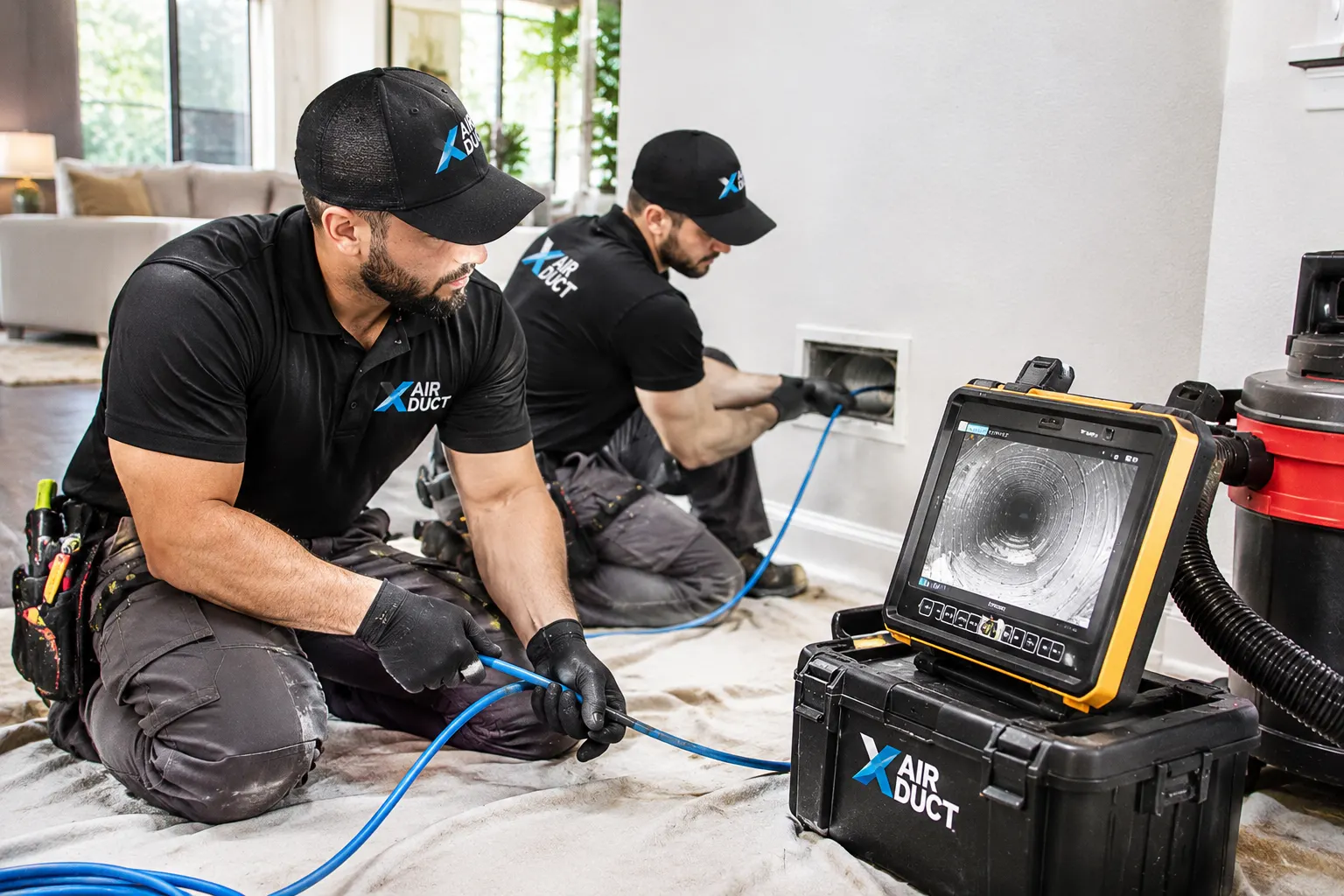
These are the questions homeowners and property managers ask most often, answered directly and with their limitations stated. Where a longer explanation helps, each answer links to a detailed guide.
How to use this resource
Scan the questions below, then follow links to deeper guides. When in doubt, request an inspection before committing to cleaning.
Our perspective
These answers reflect 18 years of hands-on industry experience at X Air Duct and published guidance from the EPA and U.S. Fire Administration. They are general information, not a substitute for evaluation of your specific property.
How often should ducts be cleaned?
There is no universal interval. The EPA recommends cleaning on an as-needed basis, such as when there is substantial visible mold growth on hard surfaces, pest infestation, or excessive dust and debris, including debris released from registers. Renovation, unknown history, and long vacancies are good reasons to inspect. See our detailed article on frequency for examples.
Will duct cleaning help my allergies?
We do not make that claim. The EPA states that duct cleaning has never been shown to actually prevent health problems. If you have health concerns, talk to a medical professional. Duct cleaning addresses debris in ducts; it is not a medical treatment.
Should I clean ducts if I see mold?
If you see what appears to be mold, the moisture source must be found and fixed first, usually by an HVAC contractor. The EPA notes that mold will return if the moisture problem is not corrected, and that some materials, such as wet insulation, may need replacement rather than cleaning. X Air Duct does not perform mold remediation or apply chemical treatments.
Can cleaning damage my ducts?
It can if the wrong tools are used. Flexible duct and duct board require gentler methods than sheet metal. Ask any provider which tools they will use on your duct material. Experienced technicians match tools to materials and report sections that are already damaged.
Do I need to leave during cleaning?
Usually not. Someone should be present at the start and end. Pets should be secured away from the work path. The equipment is loud, so some people prefer to step out during the busiest part.
What about sanitizers and coatings?
X Air Duct does not use them. The EPA advises that you fully understand the pros and cons before permitting biocides or sealants in ducts and that they should only be used after cleaning, if at all.
How do I know whether my dryer vent needs attention?
Longer drying times, a hot laundry room, lint at the door seal, and a flap that barely opens are common signs. The USFA identifies failure to clean as a leading cause of dryer fires and recommends cleaning the lint filter every load and the vent pipe periodically.
What if you find nothing wrong?
Then we tell you. A clean inspection result is valuable information, and recommending no cleaning when none is needed is part of honest service built on 18 years in the industry.
Does duct cleaning lower energy bills?
We do not promise that. Energy use depends mostly on equipment efficiency, duct sealing and insulation, thermostat settings, and the building envelope. If debris is causing a real restriction, removing it can restore airflow, but that is a specific finding, not a general benefit. Ask an HVAC contractor about efficiency improvements.
Do new homes need duct cleaning?
Usually not, unless construction debris entered the system or the system ran without a filter during construction. An inspection after moving in can confirm. If the ducts are clean, keep up the filter routine.
Should I clean ducts when I buy a home?
When the previous owner’s maintenance history is unknown, an inspection is a reasonable step. It establishes a baseline and may reveal pests, debris, or damage. Cleaning follows only if the inspection supports it.
Can I clean ducts myself?
You can remove and wash register covers and vacuum the first few inches of a boot. Cleaning further into the system requires collection equipment and agitation tools to avoid pushing debris deeper or damaging ducts. Focus your effort on filter maintenance, which has the biggest effect.
What should I expect to receive after a visit?
A clear explanation of what was cleaned, what could not be reached and why, and any observations for another trade, along with maintenance recommendations. You are welcome to see the camera before and after.
Why do you not publish prices or phone numbers?
Prices depend on the property, so we estimate after understanding it. Email at info@xairduct.com is our only published contact method, which gives you a written record of what was discussed.
Do you clean coils or repair HVAC equipment?
No. X Air Duct provides air duct cleaning, dryer vent cleaning, residential and commercial duct cleaning, and air duct and dryer vent inspection. Coil cleaning, equipment repair, dryer vent repair, sanitizing, mold remediation, and chimney work are outside our services, and we refer them.
How do I request an estimate?
Use the estimate request page to prepare an email with your service, location, property type, and details, then send it from your own email app. We reply by email.
Will cleaning remove odors?
It depends on the source. If debris, pest evidence, or contamination in the ducts is the cause, cleaning may help once the source is addressed. Odors from moisture, the drain pan, or equipment need an HVAC contractor. Odors from outside the system will not change with cleaning. Inspection helps identify which applies.
What happens to the debris removed?
Collection equipment captures debris in a filter or bag, which is removed from your home and disposed of. Registers and grilles are cleaned and reinstalled, and protective coverings are removed at the end of the visit.
How do I know if a provider is trustworthy?
Look for inspection before cleaning, specific answers about tools and scope, honest statements of limits, no health claims, no pressure to buy chemical treatments, and a willingness to say cleaning is not needed. Those habits matter more than any slogan.
Common questions
01How often should air ducts be cleaned?
The EPA recommends cleaning as needed rather than on a fixed schedule. Triggers include substantial visible buildup, debris discharging from registers, pests, or renovation dust. Some homes go many years without needing it; others need attention after a single remodel.
How often should air ducts be cleaned?02How can I recognize significant duct contamination?
Look past the grille. Light dust on a return grille is normal and, according to the EPA, not by itself a reason to clean. Significant contamination usually means visible buildup inside the duct beyond the register, debris blowing from supply registers, construction dust after a renovation, or evidence of pests. A camera inspection is the most reliable way for a homeowner to see what is really there.
Signs your air ducts may need inspection03Do I need to leave my home during air duct cleaning?
Usually not. Most people stay home, though the HVAC system will be off during the work and there will be equipment noise. Many households choose to keep pets and young children in a room away from the work path. If someone in the home is sensitive to dust or noise, discuss it beforehand so the schedule can be planned accordingly.
04Can air duct cleaning damage ductwork?
It can if the wrong tools are used. Flexible duct and duct board are more delicate than sheet metal, and aggressive brushing can tear liners or loosen connections. Ask the company what tools they use on your duct type, and how they protect flexible runs.
05Can professional cleaning eliminate all dust in my home?
No. Household dust comes from people, pets, fabrics, outdoor air, and everyday activity. Duct cleaning can remove buildup inside the duct system, but it cannot make a home dust-free, and an honest contractor will not promise that.
06What affects the cost of air duct cleaning?
The number of systems, registers, and returns, duct type, access difficulty, building rules, and whether inspection or dryer vent work is included. Be cautious of very low advertised prices that grow once a technician arrives. X Air Duct discusses scope before quoting and does not publish flat prices because properties differ.
07Can duct cleaning remove all mold?
No contractor should promise that. The EPA explains that mold is controlled by controlling moisture, and that if ducts are wet or contain moldy insulation, the moisture source must be fixed and insulation may need to be replaced rather than cleaned. Suspected mold should be evaluated appropriately before any cleaning decision.
How humidity affects indoor ventilation08Do you apply chemical treatments inside ducts?
Chemical treatment is not included in the cleaning and inspection services described here. The EPA advises homeowners to understand the pros and cons of any chemical treatment before agreeing to it. Ask about the precise scope before scheduling; do not assume cleaning includes sanitizing.
09Will you tell me if I do not need cleaning?
Yes. Cleaning on an as-needed basis is our working principle. If an inspection does not show buildup worth removing, we will say so.
10What are the warning signs of restricted dryer exhaust?
Longer drying times, clothes that are hot but damp, a hot laundry room, a hood flap that barely opens, lint around the exterior termination, or a burning smell. If you notice a burning smell, stop using the dryer until it is checked.
Signs of a restricted dryer vent11How does humidity affect ventilation?
Air conditioning removes moisture as it cools. When indoor humidity stays high, surfaces and ductwork near cold air can collect condensation. The EPA recommends keeping indoor relative humidity below 60 percent, ideally 30 to 50 percent. Duct cleaning does not control humidity; equipment sizing, operation, and moisture sources do.
How humidity affects indoor ventilation12What if you find a problem outside your services?
We explain what we observed and recommend the type of professional to contact, such as a licensed HVAC contractor or a qualified dryer vent installer. We do not perform that work ourselves.