
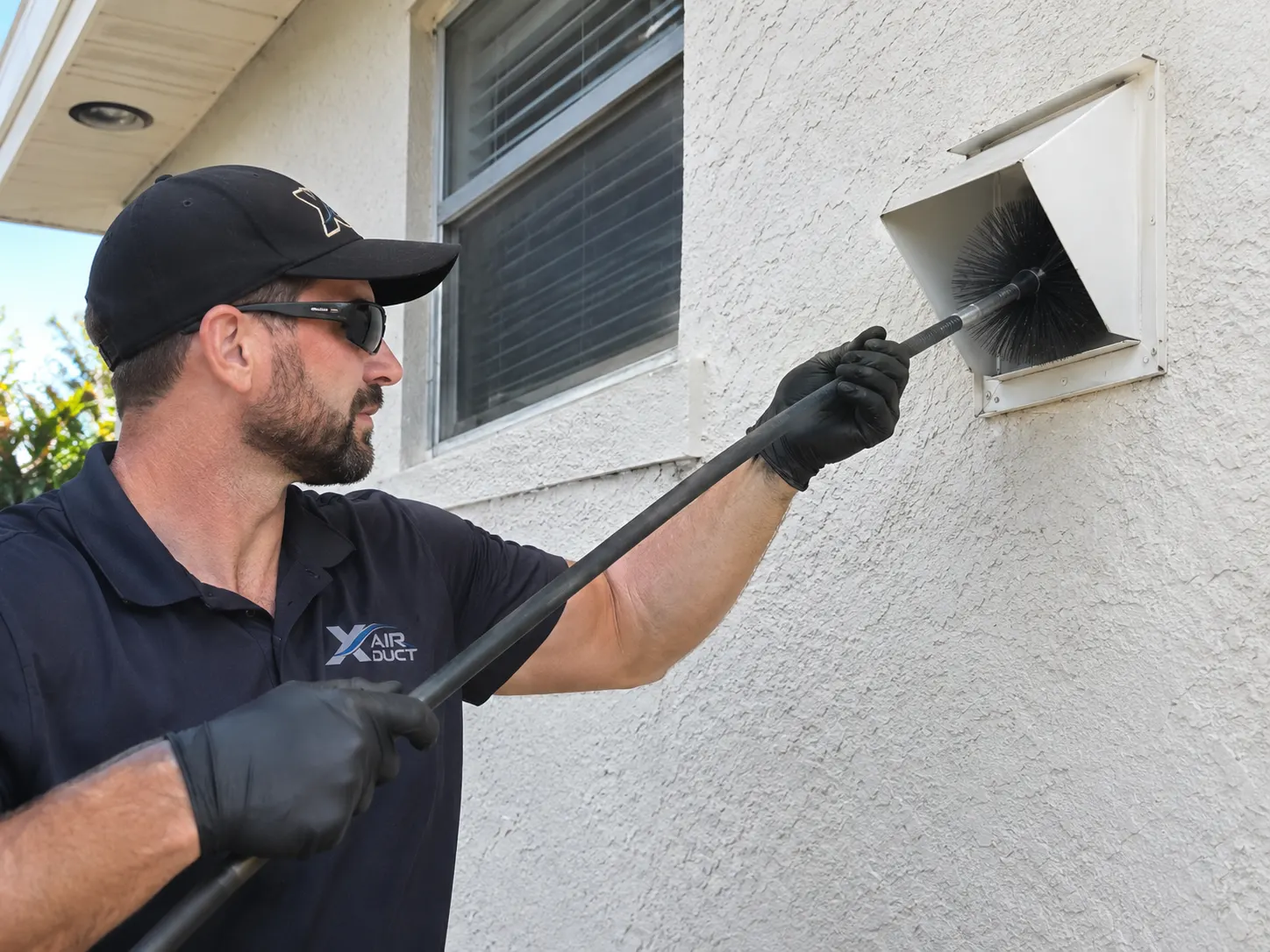
What dryer vent cleaning is
Every load of laundry pushes warm, damp, lint-laden air through a duct to the outside. The lint screen catches much of that lint, but fine fibers pass through and settle along the duct walls, at bends, and at the exterior hood. Over time that buildup narrows the path the air has to travel.
Dryer vent cleaning removes accumulated lint from the transition hose behind the dryer, the concealed duct run, and the exterior termination. The U.S. Fire Administration recommends keeping the vent and exhaust clear and cleaning the lint filter with every load, because lint is combustible.
With 18 years in the industry, X Air Duct has seen dryer vents routed through walls, attics, garages, and shared condominium chases. The routing determines how a vent should be cleaned, and sometimes reveals problems that cleaning alone will not fix.
Who may need it
- Households whose dryer is taking noticeably longer to dry a normal load.
- Homes with long or multi-bend vent runs, or vents that exit through the roof.
- Condominium owners whose dryer exhausts into a building chase or a long horizontal run.
- Large families or rental properties where the dryer runs most days.
- Anyone who has never had the concealed portion of the vent looked at.
Signs that an inspection may be useful
- Clothes come out hot but still damp, or need a second cycle.
- The laundry room feels unusually warm or humid while the dryer runs.
- The exterior hood flap barely opens, or lint is visible collecting around it.
- A burning smell, or the dryer top feels much hotter than usual. Stop using the dryer until it is checked.
The inspection and cleaning process
- 1
Ask about the setup
Where the dryer sits, where the vent exits, the building type, and recent symptoms.
- 2
Trace the route
We locate the exterior termination and estimate length and bends where they can be observed.
- 3
Disconnect and protect
The dryer is pulled out carefully and the transition connection is detached; the floor is protected.
- 4
Clean the run
Rotary brushes and collection equipment clear lint from inside the duct toward the termination.
- 5
Check airflow and reconnect
The hood is cleared, the dryer is reconnected, and exhaust at the exterior is observed.
- 6
Share findings
If we see crushed transitions, unsuitable materials, or poor terminations, we explain them so you can decide on repair with a qualified installer.
Equipment commonly used
- Flexible rotary brush rod systems that travel through the vent run.
- Collection vacuums to capture lint as it is dislodged.
- Inspection cameras for viewing concealed sections where access allows.
- Hand tools for exterior hoods and transition connections.
Safety considerations
- Gas dryers are moved with care to avoid stressing the gas connection; if a connection appears damaged we stop and recommend a qualified professional.
- Rooftop terminations are evaluated for safe access before any work is attempted.
- Lint removed from the vent is bagged and removed, not left in the laundry area.
Typical system limitations
- Some concealed runs cannot be fully observed even with a camera.
- Very long runs or runs with many bends may still perform poorly after cleaning because the design itself restricts airflow.
- Condominium chases shared by multiple units are often controlled by the association.
What this service does not accomplish
- Cleaning does not repair crushed, disconnected, or improperly installed ducts. Repair is a separate service requiring confirmation with an appropriately qualified installer.
- It does not diagnose or repair the dryer itself, such as heating elements, sensors, or the drum seal.
- It does not replace cleaning the lint filter before or after every load.
How needs differ by property
A short wall vent behind a first-floor laundry closet is a different task than a twenty-foot run through a garage ceiling or a roof termination on a two-story home. In condominiums, dryers may exhaust into a common vertical chase, and the building may have rules about who can access it. We clarify those boundaries before scheduling.
What to ask before scheduling
- Do you clean the full run to the exterior, or only the area behind the dryer?
- How do you handle roof terminations and gas dryers?
- Will you tell me if the vent material or routing looks wrong?
- In my condominium, is the vent run inside my unit or part of the building system?
How often?
Manufacturer guidance and household usage should set the schedule. Clean the lint filter every load, check the exterior hood periodically, and have the full run looked at when drying times creep up or if it has never been checked. Heavy-use households usually need attention more often than a single occupant.
Dryer Vent Cleaning: frequently asked questions
01Why does a dryer vent become blocked?
Fine lint passes the lint screen and settles in the duct, especially at bends, low spots, and the exterior hood. Long runs, crushed transition hoses, and hoods with screens accelerate buildup. Occasionally birds or pests nest in the termination.
Why dryer vent lint accumulates02Can long dryer vent runs require additional attention?
Yes. Every foot and every elbow adds resistance, and lint has more places to settle. Dryer manufacturers specify maximum vent lengths for their models. Long runs in garages, attics, or condo buildings typically need checking more often.
03What are the warning signs of restricted dryer exhaust?
Longer drying times, clothes that are hot but damp, a hot laundry room, a hood flap that barely opens, lint around the exterior termination, or a burning smell. If you notice a burning smell, stop using the dryer until it is checked.
Signs of a restricted dryer vent04What is the difference between a dryer lint trap and an exhaust vent?
The lint trap is the removable screen inside the dryer that you clean each load. The exhaust vent is the duct that carries hot, moist air from the back of the dryer to the outside. The screen catches most lint; the vent collects what gets past it.
Dryer vent cleaning vs. lint trap cleaning05Should dryer vents be inspected after installation?
It is a sensible step. Dryers are often pushed back against a wall, crushing the transition hose. A quick inspection confirms the connection, material, and exterior termination match the manufacturer installation instructions.
06When does a dryer vent need professional repair?
When a duct is crushed, disconnected, made of unsuitable material, routed beyond the manufacturer limit, or terminates improperly. Repair is separate from cleaning and inspection. Ask an appropriately qualified installer to evaluate the installation and explain any needed corrections.
When might a dryer vent need repair?Where we provide dryer vent cleaning
Available across Broward, Miami-Dade, and Palm Beach counties, including:
Photography is illustrative of the type of work we perform. It does not depict specific completed jobs or named employees.