
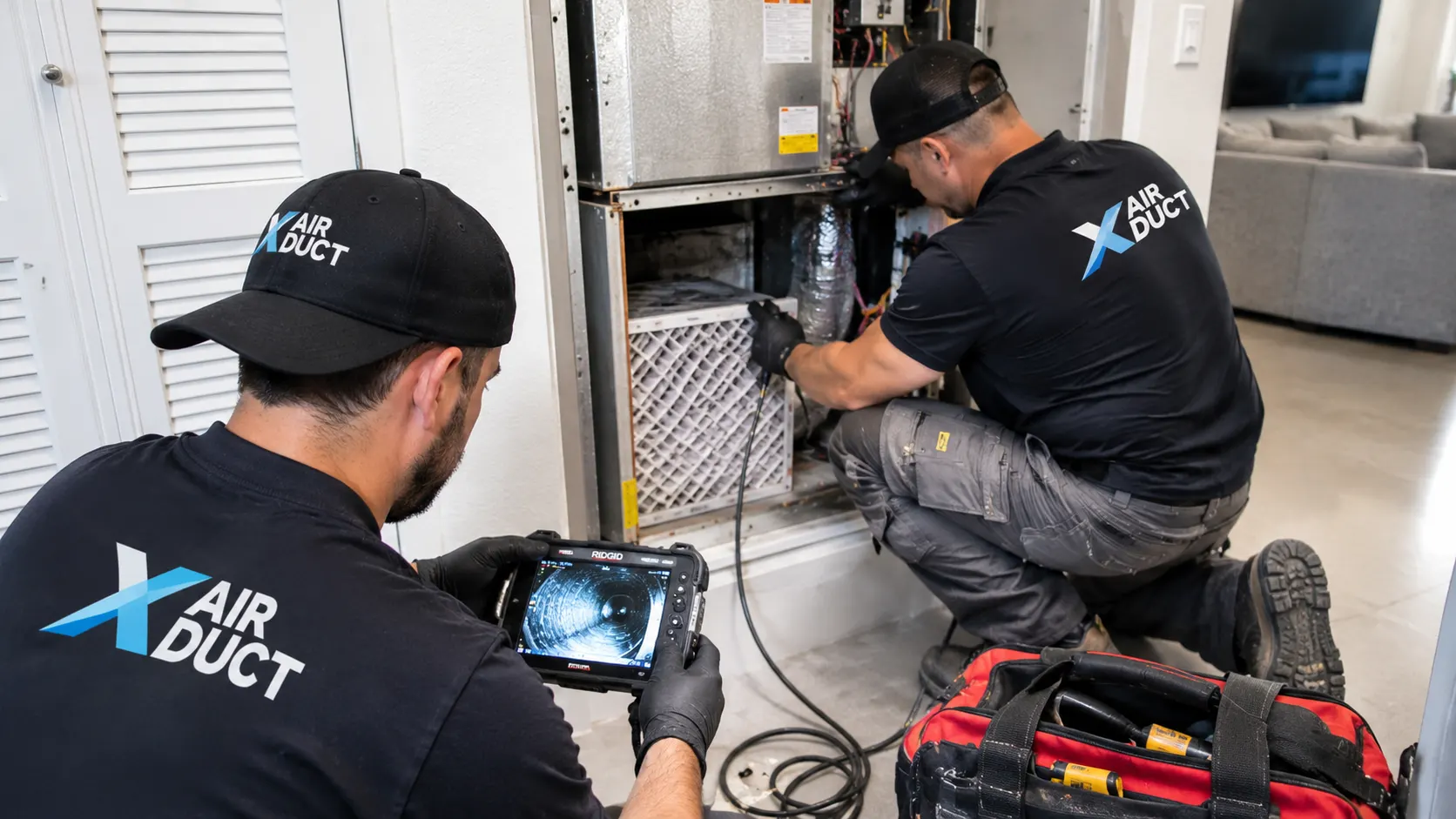
What air duct inspection is
An air duct inspection answers a simple question: is there something in this duct system worth addressing? It involves examining accessible registers, return grilles, and duct sections, often with an inspection camera that can show what lies past the first bend.
The EPA notes that a dusty return grille by itself is not proof that ducts need cleaning, because grilles catch household dust. An inspection looks further than that, which is why we believe it should come before any cleaning decision.
With 18 years of industry experience, X Air Duct can help you interpret what the camera shows: normal light dust, significant buildup, debris from construction, or signs such as moisture or damage that point to a different professional.
Who may need it
- Homeowners unsure whether cleaning is worthwhile.
- Buyers and sellers wanting to understand system condition.
- Property managers documenting condition between occupants.
- Anyone who noticed a change and wants facts before spending on cleaning.
Signs that an inspection may be useful
- You are being told you need cleaning but have not seen evidence.
- Debris appears at a register and you want to know how far it goes.
- A renovation happened while the system was running.
The inspection and cleaning process
- 1
Background
We ask about the system, recent work, and your concerns.
- 2
Register and return check
Grilles are removed where practical and the openings examined.
- 3
Camera view
An inspection camera is guided into accessible sections to view interior conditions.
- 4
Explain
We show you what we saw, with plain-language interpretation.
- 5
Recommend
Clean, monitor, or refer to another trade, whichever fits what we observed.
- 6
Plan
If no cleaning is needed, we say so and suggest when to look again.
Equipment commonly used
- Inspection cameras with articulating or push-rod cables.
- Monitors so you can watch alongside the technician.
- Flashlights, mirrors, and grille tools.
Safety considerations
- The system is turned off while the camera is in use.
- Grilles are reinstalled securely after inspection.
Typical system limitations
- Cameras show surfaces, not test results. A visual inspection cannot identify substances; suspected mold should be evaluated appropriately.
- Hidden runs behind finished construction may not be reachable.
What this service does not accomplish
- It is not an HVAC equipment diagnosis or an energy audit.
- It is not a laboratory test or an air quality certification.
How needs differ by property
Inspection depth depends on access. A home with an attic hatch and a closet air handler allows more viewing than a high-rise unit with ducts concealed in a soffit.
What to ask before scheduling
- Can I watch the camera feed with you?
- Will you tell me if cleaning is not necessary?
- What will you do if you see moisture or damage?
How often?
Inspection makes sense after renovations, before or after a property purchase, when symptoms change, or periodically if you want a baseline.
Air Duct Inspection: frequently asked questions
01How can I recognize significant duct contamination?
Look past the grille. Light dust on a return grille is normal and, according to the EPA, not by itself a reason to clean. Significant contamination usually means visible buildup inside the duct beyond the register, debris blowing from supply registers, construction dust after a renovation, or evidence of pests. A camera inspection is the most reliable way for a homeowner to see what is really there.
Signs your air ducts may need inspection02Can duct cleaning remove all mold?
No contractor should promise that. The EPA explains that mold is controlled by controlling moisture, and that if ducts are wet or contain moldy insulation, the moisture source must be fixed and insulation may need to be replaced rather than cleaned. Suspected mold should be evaluated appropriately before any cleaning decision.
How humidity affects indoor ventilation03What should I ask a contractor about duct access?
Ask which parts of the system can be reached through existing registers, returns, and access panels; whether any section will be inaccessible; and whether new access openings would be needed and who would seal them. Clear answers prevent surprises.
Where we provide air duct inspection
Available across Broward, Miami-Dade, and Palm Beach counties, including:
Photography is illustrative of the type of work we perform. It does not depict specific completed jobs or named employees.