
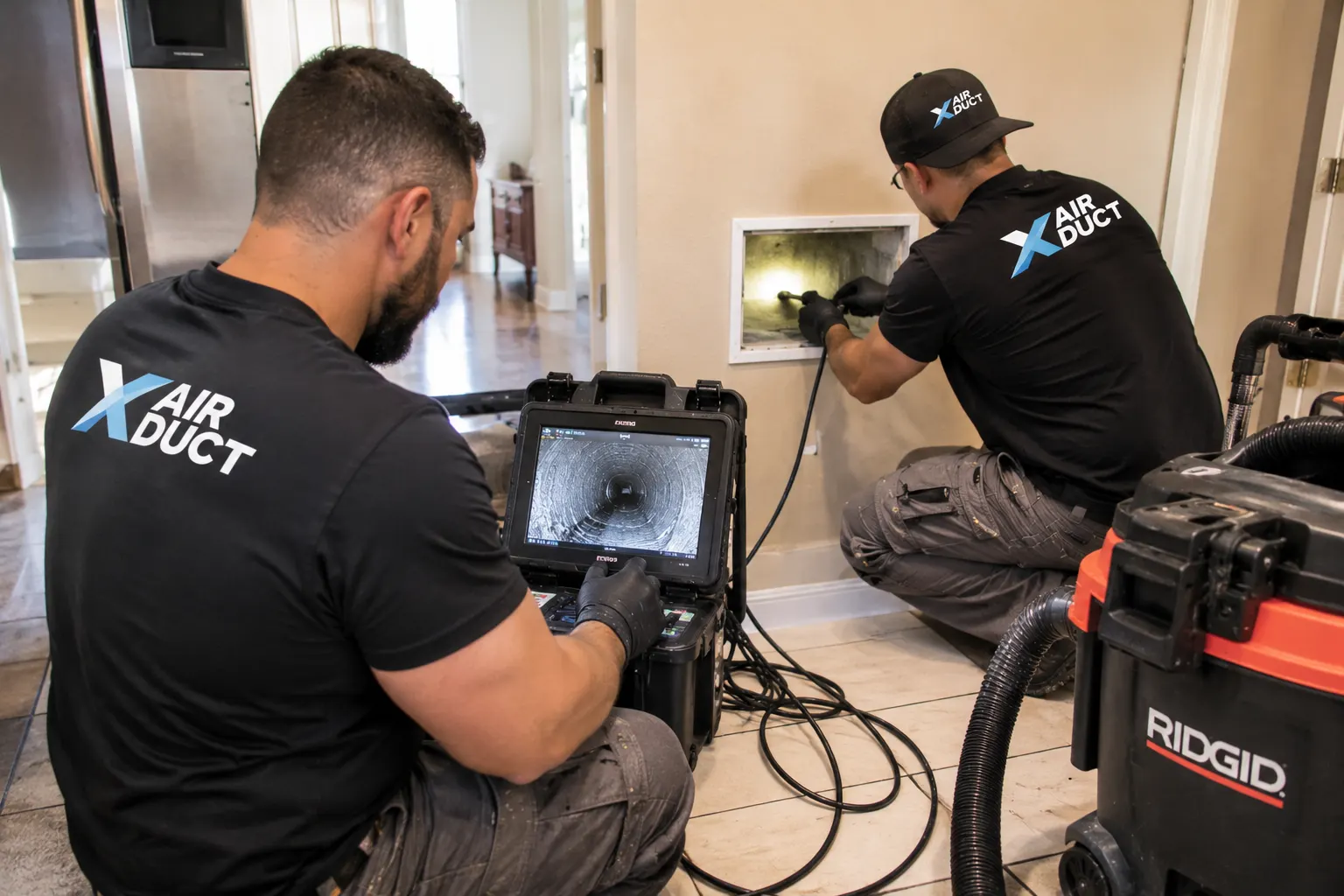
For Tamarac homes and businesses, X Air Duct offers air duct and dryer vent cleaning grounded in 18 years of hands-on industry experience. We inspect first, explain what we find, and recommend cleaning only when conditions warrant it.
Tamarac has a long history of age-restricted and retirement-oriented communities alongside newer single-family areas. Villas and attached homes may share walls and roof structures that influence how vents are routed.
Villas and attached homes
Tamarac’s villas and attached homes share walls and roof structures. Dryer vents may route through attics or roofs that the association maintains, so ownership needs to be clear before cleaning.
Long-held homes
Many Tamarac homes have had the same owner for years, and the ductwork may never have been inspected. A first inspection establishes a baseline, which is often reassuring.
Accessibility for residents
We keep work paths clear and explain each step. Residents who want a relative present for the walkthrough can arrange it.
Arrange a clear walkthrough without unnecessary disruption
For a Tamarac villa or attached home, identify the equipment you can access within your own property and ask the association about anything beyond that boundary. A roof hatch or exterior exhaust hood may not be available for an individual owner to authorize. Mention those limits early rather than expecting a cleaner to resolve ownership questions on arrival.
If you would like a relative or property representative involved, plan for that person to receive the explanation of findings. Ask what was inspected, what was cleaned if work proceeds, and what could not be reached. A short written record is more valuable for future maintenance decisions than an unsupported promise that the entire system is now problem-free.
Services available in Tamarac
Residential property considerations in Tamarac
Tamarac housing includes age-restricted communities, villas, and single-family homes. Each type brings different access, layout, and maintenance considerations.
Age-restricted and condominium village communities often have attached villas or low-rise buildings with shared roof structures. Ventilation work there typically involves association approval and careful scheduling around residents.
Single-family suburban homes usually give the most direct access to their duct systems: a closet or garage air handler, an attic hatch, and registers in every room. That accessibility makes a thorough inspection practical and lets homeowners watch the camera feed alongside the technician.
Older homes often tell a layered story. Central air may have been added decades after construction, equipment has likely been replaced more than once, and remodels may have extended, rerouted, or capped duct runs. An inspection helps sort out what is original, what was added, and where construction dust may have entered.
Commercial property considerations in Tamarac
Association-managed clubhouses and common buildings can be scoped separately from individual units.
Older commercial buildings and small storefronts may have systems that were modified as tenants changed. Inspection before cleaning clarifies what is actually connected and accessible.
How we approach a Tamarac appointment
- 01Discuss the property, system, access, and any building or HOA rules.
- 02Examine accessible registers, returns, and vent paths, often with a camera.
- 03Protect floors and furnishings along the work path.
- 04Clean with tools matched to the duct or vent material, when warranted.
- 05Explain what was cleaned and what could not be reached.
- 06Recommend maintenance habits and a sensible re-check window.
Dryer vent cleaning in Tamarac
In attached villas and low-rise condos, dryer vents may run through shared walls or the roof. Clarifying ownership with the association is the first step.
Single-story suburban homes commonly vent the dryer straight through an exterior block wall, which is short and accessible. If your laundry is in the garage or an interior room, the run may be longer and pass through the ceiling.
Whatever the route, the U.S. Fire Administration recommends cleaning the lint filter with every load and keeping the vent and exterior exhaust clear. X Air Duct cleans and inspects dryer vents; if we find crushed, disconnected, or improperly installed ducts, we explain what we see so you can contact a qualified installer.
Ventilation care for Tamarac properties
Residents who prefer to have a family member present during service can mention that when scheduling; we are glad to explain findings to everyone involved.
Families with pets and busy households load filters faster. Check them monthly and replace with the size and type your equipment specifies.
Across Tamarac, as everywhere in South Florida, air conditioning runs much of the year. That makes filter discipline, condensate drain maintenance by a licensed HVAC contractor, and indoor humidity control (the EPA recommends below 60 percent, ideally 30 to 50 percent) the foundation of good ventilation care. Duct cleaning complements those habits; it does not replace them.
Questions from Tamarac property owners
01Does X Air Duct serve Tamarac, FL?
Yes. Tamarac is part of our service area in Broward County. Email info@xairduct.com or use the estimate request page to share your address details and the service you are interested in.
02Do I need association approval in an adult community?
Often yes. Check your community rules for contractor registration, hours, and parking before scheduling, and let us know any requirements when you reach out.
03How do I prepare my single-family home for duct cleaning?
Clear access to registers, returns, the air handler, and the attic hatch; secure pets; and plan to be there for the opening assessment and closing walkthrough.
04My home is older and has been renovated. Where should I start?
Start with an inspection. Renovations commonly introduce construction dust and duct modifications, and an inspection shows whether cleaning is needed and whether anything should be referred to an HVAC contractor.
05How often should Tamarac homeowners clean their air ducts?
There is no fixed interval. Following EPA guidance, consider cleaning when inspection shows substantial buildup, after renovations, or after pest activity has been resolved. Many homes need it infrequently.